Resource
CPO fees for home charging, explained
Paying a charge point operator for every employee’s home charging station? See what CPO fees cover, the downsides, and how to reimburse without them.
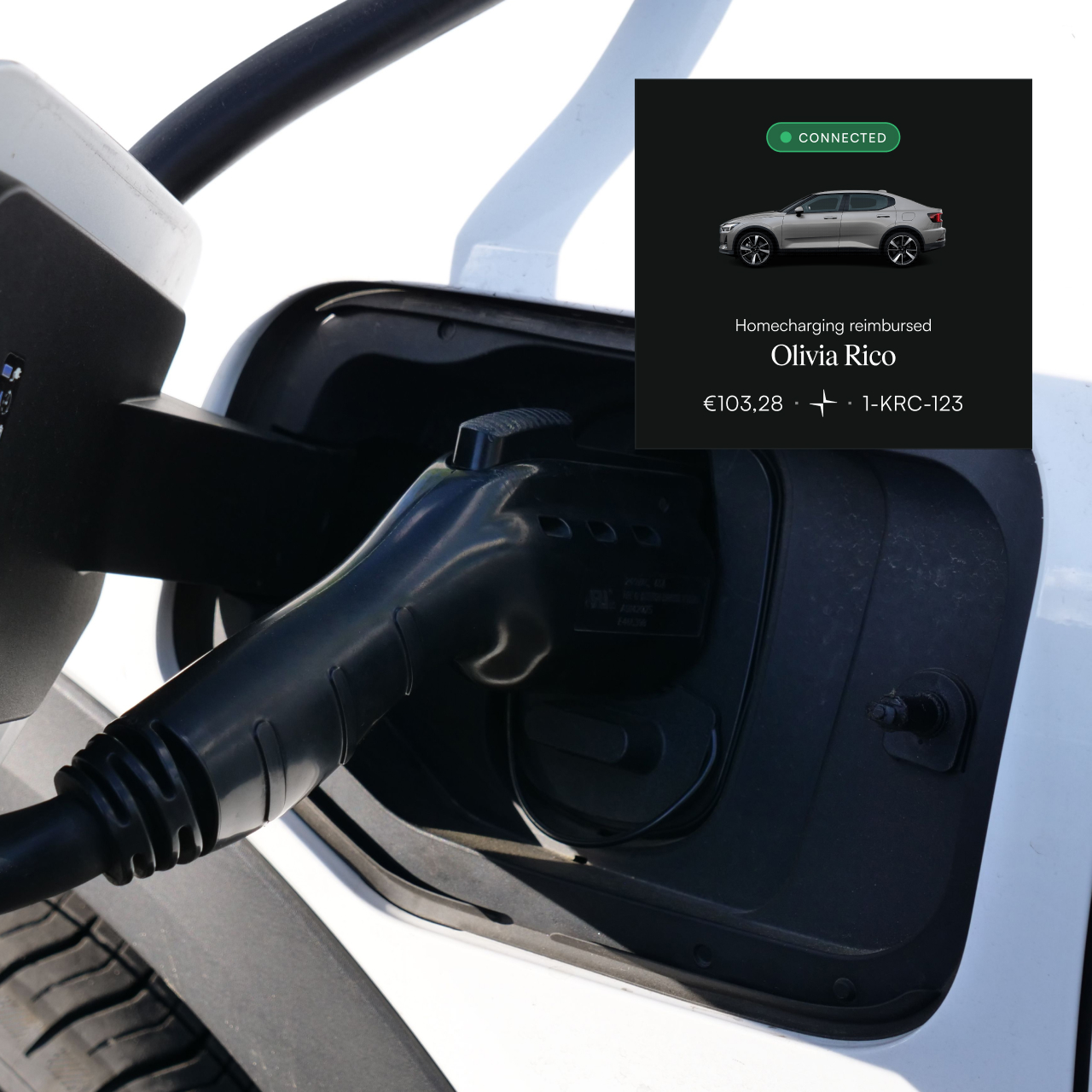
In short: many employers pay a charge point operator (CPO) for every home charging station, mainly to measure home charging and reimburse it. Those costs add up: a subscription per station, back-office or transaction fees, charge cards and one-off fees when a station is moved or replaced. The model also ties you to one supplier and only works if every employee has the same connected station. You don’t need a CPO to reimburse home charging. EEVEE Mobility reads the charging data from the company car itself, for 20+ car brands and without extra hardware, so in most cases employees can keep the charging station they already have.
Why employers pay a CPO for home charging
When companies started switching to electric company cars, many installed a connected charging station at each employee’s home. To measure the electricity and reimburse it, the station was linked to a charge point operator (CPO): the company that runs the platform behind the charging station.
At the time, that made sense. The charging station was the only reliable source of data about home charging. Today, the car itself records its charging sessions. So it’s worth asking what you are still paying the CPO for, and whether you need one at all.
What does a CPO do for a home charging station?
A CPO connects the charging station to its back-office platform over the internet. For a home charging station, that platform usually:
- starts and authorises charging sessions, often with a charge card or an app;
- logs each session and the kWh delivered;
- passes that data on so the employer can reimburse the employee;
- provides remote support, software updates and sometimes smart charging features.
For a public charging network, these services are essential. For one charging station in an employee’s driveway that mainly charges one company car, a lot of it is overhead.
Which recurring costs do you pay per charging station?
Pricing differs by provider and contract, but CPO costs for home charging usually fall into a few types:
- Subscription per station: a monthly or yearly fee to keep each station connected to the CPO platform.
- Back-office or transaction fees: a charge per session, per kWh or per reimbursement processed.
- Charge card costs: fees for the cards or badges used to start a session.
- One-off costs: activation, configuration, or a technician visit when a station is moved, replaced or reconfigured.
Each fee may look small on its own. Multiply it by every employee with an electric company car and every month of the contract, and it becomes a fixed cost line that doesn’t add a single kWh to the battery.
The downsides of a CPO-based setup
Vendor lock-in
Your reimbursement process depends on one provider’s platform. Switching provider can mean reconfiguring or replacing every station and moving your data to a new system.
Every employee needs the same connected station
The process only works if each employee has a compatible station on that platform. Employees who already own a different charging station, or who charge from a socket, fall outside it.
Employees move, join and leave
When an employee moves house, the station has to be removed, reinstalled or replaced, and the contract updated. New employees may arrive with a station that is tied to another platform.
Apartments and shared car parks
Employees who live in an apartment or park in a shared garage often can’t install their own connected station. They still expect a fair reimbursement for the charging they do at home.
Do you need a CPO to reimburse home charging?
No. What you need is reliable data on how much electricity the company car charged at home. The car already records that.
EEVEE Mobility receives charging data straight from the vehicle, through the car manufacturer’s API. It works with more than 20 car brands and needs no extra hardware. Every charging session is classified as home, work or public, and the home charging reimbursement is calculated at the rate you agreed with your employees. All of this is GDPR-compliant.
Because the data comes from the company car itself, the charging station doesn’t need to report anything. If a partner or housemate charges their own car on the same station, that session isn’t counted.
What happens to the charging stations employees already have?
In most cases, employees can keep using the charging station they already have. Before you change anything, check these points:
- Does the station work without a CPO subscription? That depends on the model. Some stations can be set to start charging without a card or app; others need to stay connected. Ask the installer or supplier.
- What does your contract say? Look at notice periods, minimum terms and any costs for disconnecting or reconfiguring stations. Stations that are part of a lease contract may need to stay connected until it ends.
- Are you reimbursing twice? If a station stays connected to a CPO for a while, reimburse home charging through one process only: either the old platform or vehicle data.
Does a CPO make a charging station “smart”?
Not necessarily. Features such as scheduled charging or load management often depend on the charging station and the home installation rather than on the CPO subscription. Ask your installer which features stay available if the subscription stops.
Home charging without the overhead
Connected stations and CPO platforms made sense when the charging station was the only source of data. Now that the car records its own charging sessions, you can reimburse home charging fairly: without a subscription per station, without requiring the same hardware for everyone, and without redoing the setup every time an employee moves.
Want to see how EEVEE Mobility reimburses home charging from vehicle data? Book a demo.
Frequently Asked Questions
Resource
Charging a company car at home: 5 options
Socket, smart cable or charging station? Compare home charging options for company cars, the charging speed you really need and how to reimburse it.
Resource
MID meter or vehicle data: which is accurate?
MID-certified charger or data from the car? Learn what makes EV charging data reliable enough to reimburse home charging, and what MID does and doesn’t cover.

Resource
Fleet home charging: what fleet managers need to know
Growing your electric fleet? Discover how to manage home charging and control charging costs without installing a home charger for every employee.

For fleet managers of the modern era


